A megabyte in 56µs at p99. 200 Gbps at 1.6% CPU.
Rasa is an easy to use RDMA cache for AWS. Values live in registered memory on the data nodes; clients read them directly over EFA with one-sided RDMA, so large reads scale with NIC bandwidth, not server CPU.
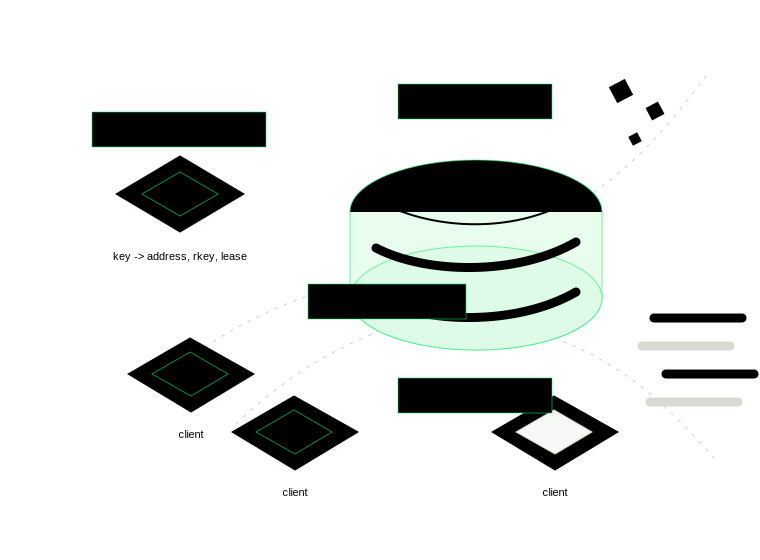
Rasa makes RDMA simple.
Unbelievable p99s
Remote reads from a c8gn.16xl, at the connection count that keeps latency near its floor.
p99 by value size
Your VPC. Your nodes.
Clients and a fleet of data nodes share an EFA placement group per AZ. Valkey is the control plane, not the data plane: it maps keys to descriptors, and the values never flow through it.
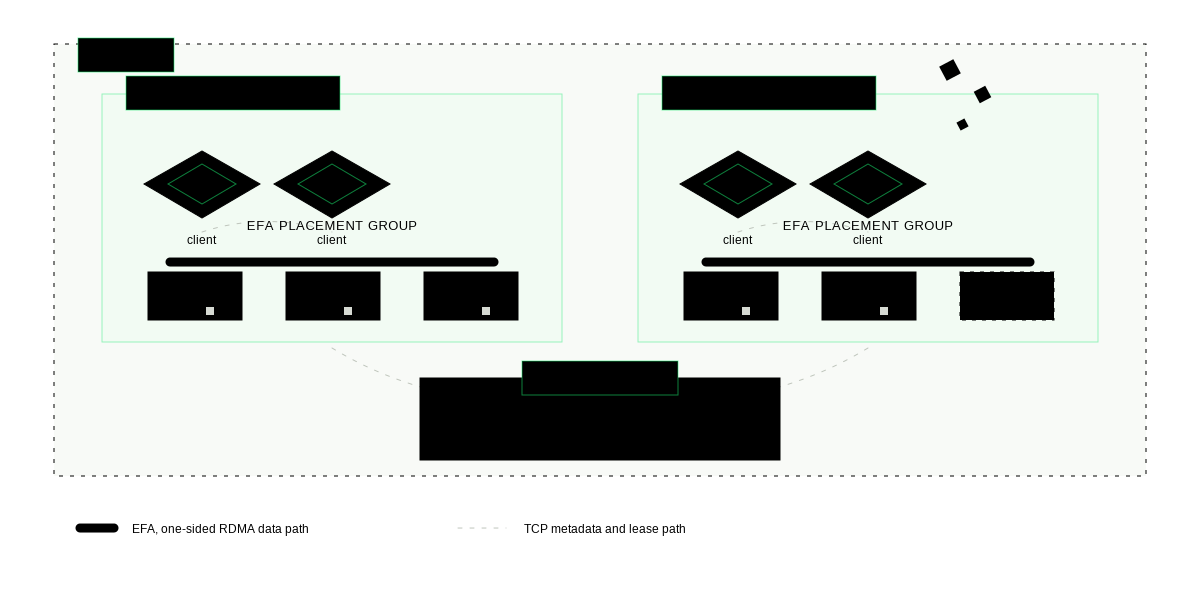

A Valkey-powered control plane.
Valkey runs the exchange. Every read, write, and delete starts there: it maps each key to its Rasa descriptor and hands the client the address, rkey, and lease it needs, then coordinates slot allocation, node membership, and memory reclamation across the data nodes. It is the brain that makes one-sided RDMA both findable and safe.
Read: one descriptor lookup in Valkey, then a one-sided RDMA pull straight from the data node's registered memory. The node's CPU is off the read path.
You never touch the fabric.
Doing RDMA by hand means libfabric, queue pairs, memory registration, remote keys, completion-queue polling, and getting EFA's SRD transport and security groups exactly right. Rasa keeps all of it behind a key/value API.
Rasa owns the fabric code
Memory registration, rkeys, descriptor refresh, leases, and completion polling all stay behind the client API. You never touch a fabric primitive.
EFA set up at deploy
Provider discovery, SRD, address exchange, and the security-group gotchas are configured when you stand it up, not debugged at 2 a.m.
Just three calls
The whole client API is get, put, delete. Addressing, leasing and fencing live behind it.
200 Gbps. ~1 server core.
The data node never touches a read: it serves the full 200 Gbps line rate, at any value size, on about one core. The NIC moves the bytes, so throughput tracks the NIC, not the CPU you pay for.
Fast because it does less.
Large values, small latency
Built for 128 KiB to 16 MiB objects, read in tens of microseconds to under a millisecond at p99. A full megabyte in 56µs.
Bandwidth, not cores
Reads bypass the server CPU entirely, so throughput scales with the NIC. One data node serves 200 Gbps of remote reads.
Simple and safe
Three calls: get, put, delete. Values are immutable and validated on every read; memory is reclaimed safely by lease and rkey rotation.
One data node. 200 Gbps of remote-memory reads.
50µs remote reads are more economical than you think.
c8gn.16xlarge.c8gn.16xlarge.What it gives up to go this fast.
One-sided reads are fast because the server is not involved, which also shapes what the system promises. We leaned into the constraints instead of hiding them.
Write-once, immutable
Values do not change in place; deletes are lazy. Durability is a cache contract: lose a node and you recompute. That immutability is what makes a one-sided read safe to serve without a lock.
Reclaim by time, not locks
A one-sided read is invisible to the server, so in-flight readers cannot be counted. Memory is reclaimed only after leases expire and the remote key is rotated: a hardware fence, not a mutex.
One fabric, done well
Single-tenant, AWS with EFA on Linux. We chose depth on one fabric over a lowest-common-denominator abstraction that is mediocre on all of them.
From the blog.
Try a 200 Gbps remote-memory cache in your own AWS account.
Single-tenant, self-hosted, EFA-native. An early preview you benchmark in your own VPC.